My work focuses on developing new understandings of contemporary wealth inequality. In particular, I look at how the growing gap between the very richest and the rest of us came to be, how those patterns differ and change across countries, and who the beneficiaries are.
A few of my ongoing or completed projects are below.
Research Articles
Economic Elites and Wealth Concentration Cross-Nationally, 1996-2025
Who benefits from wealth concentration? And, does the composition of the elite matter for how concentrated wealth becomes?
Abstract
Wealth concentration has risen globally over the past three decades, yet we know little about who constitutes the economic elite or how patterns vary across institutional contexts. I argue that wealth concentration should be viewed as a dual-outcome process: asset markets determine concentration levels, while institutional mechanisms select which types of actors accumulate the most wealth. To examine these outcomes, I introduce the International Database on Economic Elites and their Wealth (IDEE Wealth), which tracks the wealth and social characteristics of the economic elite using harmonized rich list data. Using data on 5,366 billionaires across 84 countries from 1996 to 2025, I develop three findings. First, wealth concentration has risen broadly, with the billionaire share of global household wealth nearly tripling from 1.1 to 3.0 percent, but levels vary across countries. Second, elite composition patterns according to institutional similarity: liberal market economies produce mixed elites, while coordinated and mixed market economies produce heir-dominated elites. Third, there is no positive correlation between the share of heirs or entrepreneurs and a country’s concentration level. These findings challenge existing accounts linking rising concentration to elite composition and suggest that asset markets determine whether wealth becomes concentrated, but context-specific institutions determine who controls it.
Silver Spoons, Bootstraps, and Billionaires: The Social Origins of the Contemporary American Economic Elite
Were the wealthiest Americans born rich, or did they rise from humble beginnings? I use new administrative data to trace the childhood circumstances of the richest Americans and examine the social origins of extreme wealth.
Abstract
The share of inherited fortunes among the wealthiest Americans has declined sharply over the past four decades, a trend widely interpreted as evidence that the top of the wealth distribution has become more open. But do “self-made” elites actually come from a broad cross-section of society, or are they drawn predominantly from privileged backgrounds? I address this question by linking more than 1,100 Americans appearing on the Forbes 400 and Forbes World’s Billionaires lists (1982–2025) to their childhood U.S. Census records (1900–1950) and comparing their family backgrounds to those of the broader population. The results show that today’s richest Americans overwhelmingly grew up in families with substantial housing wealth, high-status occupations, and other markers of elite status. Even among those commonly described as “self-made,” childhood circumstances remain strongly advantaged relative to the general population, while origins in the lower reaches of the socioeconomic distribution are exceedingly rare. Taken together, these findings suggest that the decline in inherited fortunes reflects circulation within already privileged strata rather than a broad opening of access to extreme wealth.
The Making of the Contemporary U.S. Economic Elite in Financial Markets
What explains the rapid increase in wealth concentration in the U.S. since the 1980s? I argue that the answer lies in a series of institutional shifts within financial markets and the organization of firms.
Data Visualizations
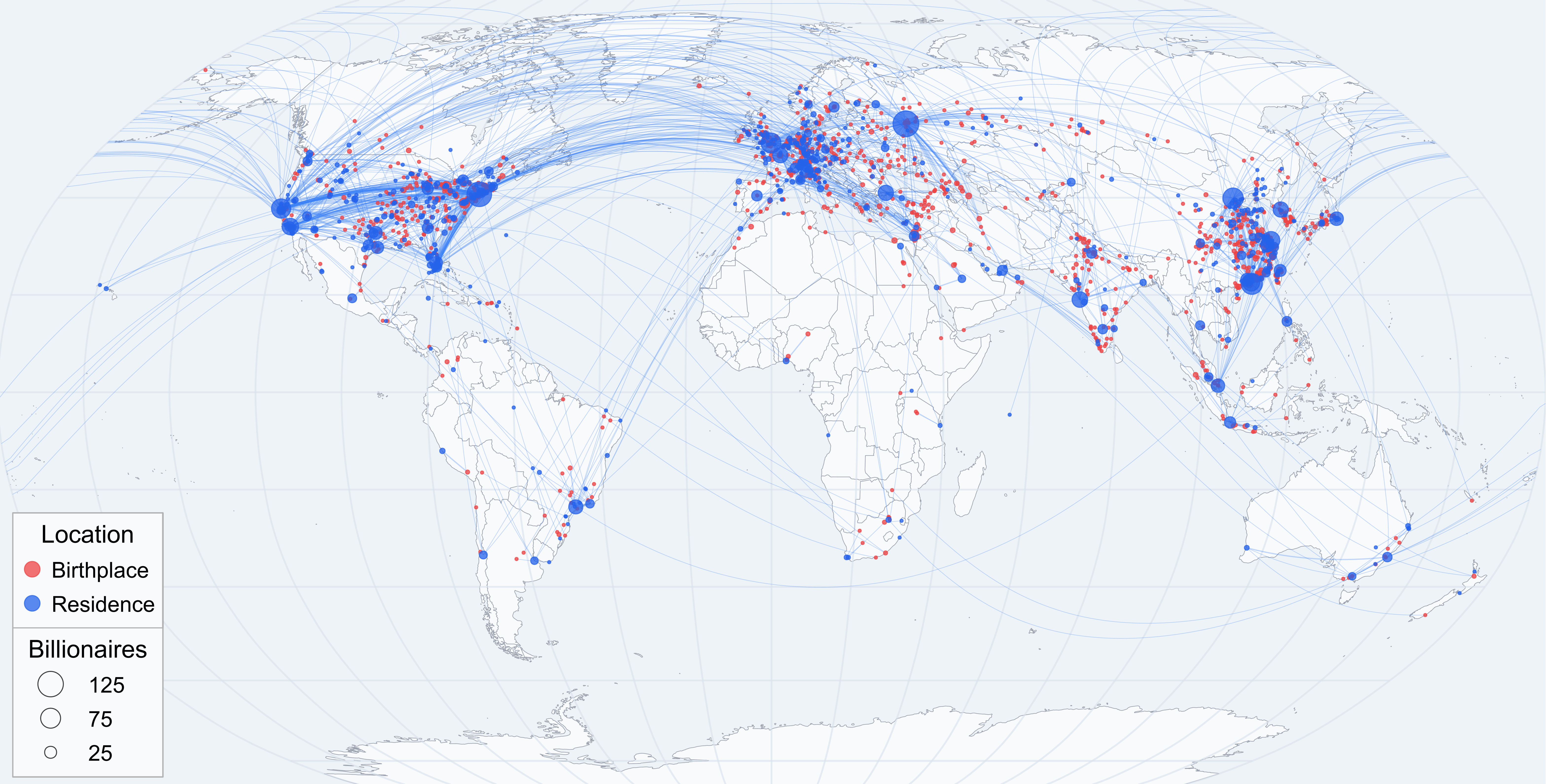
Mapping the Migration Patterns of the Global Economic Elite
Where do billionaires come from and where do they live now? This interactive map allows you to explore, by birthplace and most recent residence location, the geographic roots of more than 3,100 of the world’s richest individuals.
Abstract
Where do billionaires come from and where do they live? This data visualization maps the migration patterns of more than 3,100 billionaires using the International Database on Economic Elites and their Wealth (IDEE Wealth), a new dataset tracking the wealth and social characteristics of the global economic elite using publicly available sources. By linking residence data from Forbes with demographic data drawn from media, administrative, and other sources, the visualization illustrates migration flows for the world’s richest individuals from birthplace to most recent residence. The result describes the varied origins and contemporary spatial concentration of an elite possessing approximately 2.5 percent of all global wealth in 2024, a population of particular relevance for the study of elites, wealth inequality, and contemporary debates on tax policy.